头文件
现在的C++标准库头文件不带后缀:
注释行
以 // 开始注释内容只能在本行起作用
以 \*..*\ 方式的注释为其之间的所有内容
C++ 的输入输出
C++ 提供了更安全的和更方便的 I/O 写法。
std::cout std::cin
1
|
std::cout << (1 << 2) << std::endl;
|
灵活的局部变量声明
C++ 运行在代码块的任何地方声明局部变量
结构、联合和枚举名可以直接作为类型名
定义变量时不必再结构名、联合名或枚举名前冠以 struct、union 和 enum。
C 语言:
1
2
3
4
5
6
|
typedef struct Point
{
    int x, y;
}PT;

Point pt;
|
C++:
1
2
3
4
5
6
|
struct Point
{
    int x, y;
};

Point pt;
|
啰啰嗦嗦的 struct 的新特性:
 1
 2
 3
 4
 5
 6
 7
 8
 9
10
11
12
13
14
15
16
17
18
19
20
21
22
|
{
    /*
        struct Point
        {
            int x, y;
        };

        Point pt = {1, 2};
    */
    struct Point
    {
        int x, y;
        Point(int x, int y) : x(x), y(y)
        {
            std::cout << x << " " << y << std::endl;
        }
    };

    Point pt(1, 2);

    return 0;
}
|
const 修饰符
不好的码风:
1
|
for (index = 0; index < 512; ++index)
|
512 可读性不好。
可以这样:
1
2
|
int bufSize = 512;
for (index = 0; index < bufSize; ++index)
|
但是用 const 就更好:
1
2
|
const int bufSize = 512;
for (index = 0; index < bufSize; ++index)
|
预编译时的符号替换
无类型
define 不安全,直接替换。补救:(),do{}while(0)
const 即常量修饰符。
const 指针
用例:
 1
 2
 3
 4
 5
 6
 7
 8
 9
10
|
int value = 10;
int other = 20;
const int *p1 = &value;
//*p1 = 30; //报错
// p1 = &other; // 可以运行
std::cout << "p1=" << *p1 << ";" << "value=" << value << std::endl;
int *const p2 = &other;
// *p2 = 30; // 可以运行
// p2 = &value; // 报错
std::cout << "p2=" << *p2 << ";" << "other=" << other << std::endl;
|
地址不能变,但是值可以变
地址能变,但是值不能变
勘误:
1
2
|
    char * const name = "chen";
    name[3] = 'a';  // 段错误
|
编译通过,但是运行时错误(非法访问)
应该这样写:
1
2
|
char arr[] = "chen";
name[3] = 'a';
|
勘误:如果 const 定义是一个整形常量,关键字 int 可以省略。(现在不能省略)
- 函数形参可以用 const 说明,用于保证形参在函数内部不被改动。
函数原型
在 C++ 中有如下几种声明方式:
1
2
3
|
int add (int a, in b);
int add(); // 有警告
add(); // 现在已经不行了
|
C++ 中函数原型的定义形式:
类型 函数名(参数类型说明列表)
1
2
|
int sum(int, int);
int sum(int a, int b);
|
main 声明一定为 int 型。
内联函数
1
2
3
4
|
int min(int v1, int v2)
{
    return (v1 < v2 ? v1 : v2);
}
|
调用函数比直接计算条件操作符要慢
可以使用 define
1
|
#define min(v1, v2) ((v1) < (v2) ? (v1) : (v2))
|
但是有时候这种方式会有奇奇怪怪的问题:
1
2
3
4
5
6
7
8
|
#define min(v1, v2) ((v1) < (v2) ? (v1) : (v2))
int main(int argc, char *argv[])
{
    int x = 3, y = 5, z;
    z = min(x++, y);
    std::cout << z << " " << x;
    return 0;
}
|
输出: 4 5 ,显然 x 值预期应该是 4 因为显式的 x 只自增了一次
可以用 inline 采用内联函数,消除 define 的不安全因素
1
2
3
|
inline int min(int v1, int v2) {
    return (v1 < v2 ? v1 :v2);
}
|
它将在程序中每个调用点上被内联地展开
1
2
3
|
int a = min(n, m);
// 编译后变成
int a = n < m ? n : m;
|
inline 对编译器来说只是一个建议,具体是否内联看编译器
使用策略:只优化小的、只有几行的、经常被调用的函数
将该代码编译后 objdump 反汇编来探究:
__attribute__ 可以设置函数属性
 1
 2
 3
 4
 5
 6
 7
 8
 9
10
11
12
13
14
15
16
17
18
19
|
__attribute__((noinline))
inline int min_noinline(int v1, int v2)
{
    return (v1 < v2 ? v1 :v2);
}

__attribute__((always_inline))
inline int min_inline(int v1, int v2)
{
    return (v1 < v2 ? v1 :v2);
}
int main(int argc, char *argv[])
{
    int x = 3, y = 5, z;
    z = min_inline(x++, y);
    z = min_noinline(x++, y);
    std::cout << z << " " << x;
    return 0;
}
|
反汇编:
 1
 2
 3
 4
 5
 6
 7
 8
 9
10
11
12
13
14
15
16
17
18
19
20
21
22
23
24
25
26
27
28
29
30
31
32
33
34
35
36
37
38
39
40
41
42
43
44
45
46
47
48
49
50
51
52
53
54
55
56
57
58
59
60
61
|
0000000000001149 <main>:
    1149:	55                   	push   %rbp
    114a:	48 89 e5             	mov    %rsp,%rbp
    114d:	48 83 ec 30          	sub    $0x30,%rsp
    1151:	89 7d dc             	mov    %edi,-0x24(%rbp)
    1154:	48 89 75 d0          	mov    %rsi,-0x30(%rbp)
    1158:	c7 45 ec 03 00 00 00 	movl   $0x3,-0x14(%rbp)
    115f:	c7 45 f0 05 00 00 00 	movl   $0x5,-0x10(%rbp)
    1166:	8b 45 ec             	mov    -0x14(%rbp),%eax
    1169:	8d 50 01             	lea    0x1(%rax),%edx
    116c:	89 55 ec             	mov    %edx,-0x14(%rbp)
    116f:	89 45 f8             	mov    %eax,-0x8(%rbp)
    1172:	8b 45 f0             	mov    -0x10(%rbp),%eax
    1175:	89 45 fc             	mov    %eax,-0x4(%rbp)
    1178:	8b 45 f8             	mov    -0x8(%rbp),%eax
    117b:	3b 45 fc             	cmp    -0x4(%rbp),%eax
    117e:	7d 05                	jge    1185 <main+0x3c>
    1180:	8b 45 f8             	mov    -0x8(%rbp),%eax
    1183:	eb 03                	jmp    1188 <main+0x3f>
    1185:	8b 45 fc             	mov    -0x4(%rbp),%eax
    1188:	89 45 f4             	mov    %eax,-0xc(%rbp)
    118b:	8b 45 ec             	mov    -0x14(%rbp),%eax
    118e:	8d 50 01             	lea    0x1(%rax),%edx
    1191:	89 55 ec             	mov    %edx,-0x14(%rbp)
    1194:	8b 55 f0             	mov    -0x10(%rbp),%edx
    1197:	89 d6                	mov    %edx,%esi
    1199:	89 c7                	mov    %eax,%edi
    119b:	e8 43 00 00 00       	call   11e3 <_Z12min_noinlineii>
    11a0:	89 45 f4             	mov    %eax,-0xc(%rbp)
    11a3:	8b 45 f4             	mov    -0xc(%rbp),%eax
    11a6:	48 8d 15 93 2e 00 00 	lea    0x2e93(%rip),%rdx        # 4040 <_ZSt4cout@GLIBCXX_3.4>
    11ad:	89 c6                	mov    %eax,%esi
    11af:	48 89 d7             	mov    %rdx,%rdi
    11b2:	e8 89 fe ff ff       	call   1040 <_ZNSolsEi@plt>
    11b7:	48 89 c2             	mov    %rax,%rdx
    11ba:	48 8d 05 43 0e 00 00 	lea    0xe43(%rip),%rax        # 2004 <_IO_stdin_used+0x4>
    11c1:	48 89 c6             	mov    %rax,%rsi
    11c4:	48 89 d7             	mov    %rdx,%rdi
    11c7:	e8 64 fe ff ff       	call   1030 <_ZStlsISt11char_traitsIcEERSt13basic_ostreamIcT_ES5_PKc@plt>
    11cc:	48 89 c2             	mov    %rax,%rdx
    11cf:	8b 45 ec             	mov    -0x14(%rbp),%eax
    11d2:	89 c6                	mov    %eax,%esi
    11d4:	48 89 d7             	mov    %rdx,%rdi
    11d7:	e8 64 fe ff ff       	call   1040 <_ZNSolsEi@plt>
    11dc:	b8 00 00 00 00       	mov    $0x0,%eax
    11e1:	c9                   	leave
    11e2:	c3                   	ret

00000000000011e3 <_Z12min_noinlineii>:
    11e3:	55                   	push   %rbp
    11e4:	48 89 e5             	mov    %rsp,%rbp
    11e7:	89 7d fc             	mov    %edi,-0x4(%rbp)
    11ea:	89 75 f8             	mov    %esi,-0x8(%rbp)
    11ed:	8b 45 fc             	mov    -0x4(%rbp),%eax
    11f0:	3b 45 f8             	cmp    -0x8(%rbp),%eax
    11f3:	7d 05                	jge    11fa <_Z12min_noinlineii+0x17>
    11f5:	8b 45 fc             	mov    -0x4(%rbp),%eax
    11f8:	eb 03                	jmp    11fd <_Z12min_noinlineii+0x1a>
    11fa:	8b 45 f8             	mov    -0x8(%rbp),%eax
    11fd:	5d                   	pop    %rbp
    11fe:	c3                   	ret
|
可见只有 min_noinline 函数,而没有 min_inline 函数,min_inline 内联展开到 main 函数了。
带有默认参数的函数
在函数定义或函数声明中指定了初始值的参数称为默认参数。
1
|
int special(int x = 5, double y = 5.3);
|
调用的时候可以不给任何参数,直接用默认参数。
默认参数必须从右向左连续定义,不能跳跃,并且在一个默认参数的右边不能有未指定到默认值。
函数定义在前,函数声明在后,函数定义中指定默认值。
函数调用在前,函数定义在后,函数声明中指定默认值,在函数定义时就不要给了。
1
2
|
//例如这样不行
void fun(int w, int x = 2, int y, int z = 1);
|
可以在新的作用域内重新声明函数的默认参数:
但是在同一个作用域里面没办法做。
 1
 2
 3
 4
 5
 6
 7
 8
 9
10
11
12
13
14
15
16
17
18
|
#include <iostream>

void fun(int x, int y = 1);

int main(int argc, char *argv[])
{
    fun(3);
    void fun(int x, int y = 0);
    // fun(2, 0);
    fun(2);

    return 0;
}

void fun(int x, int y)
{
    std::cout << x << " " << y << std::endl;
}
|
输出:
函数的重载
参数类型不同的函数重载
1
2
|
int mul(int x, int y);
int mul(double x, double y);
|
参数个数不同的函数重载
1
2
|
double mul(double x, double y);
double mul(double x, double y, double z);
|
调用重载函数时,函数返回值不在参数匹配检查
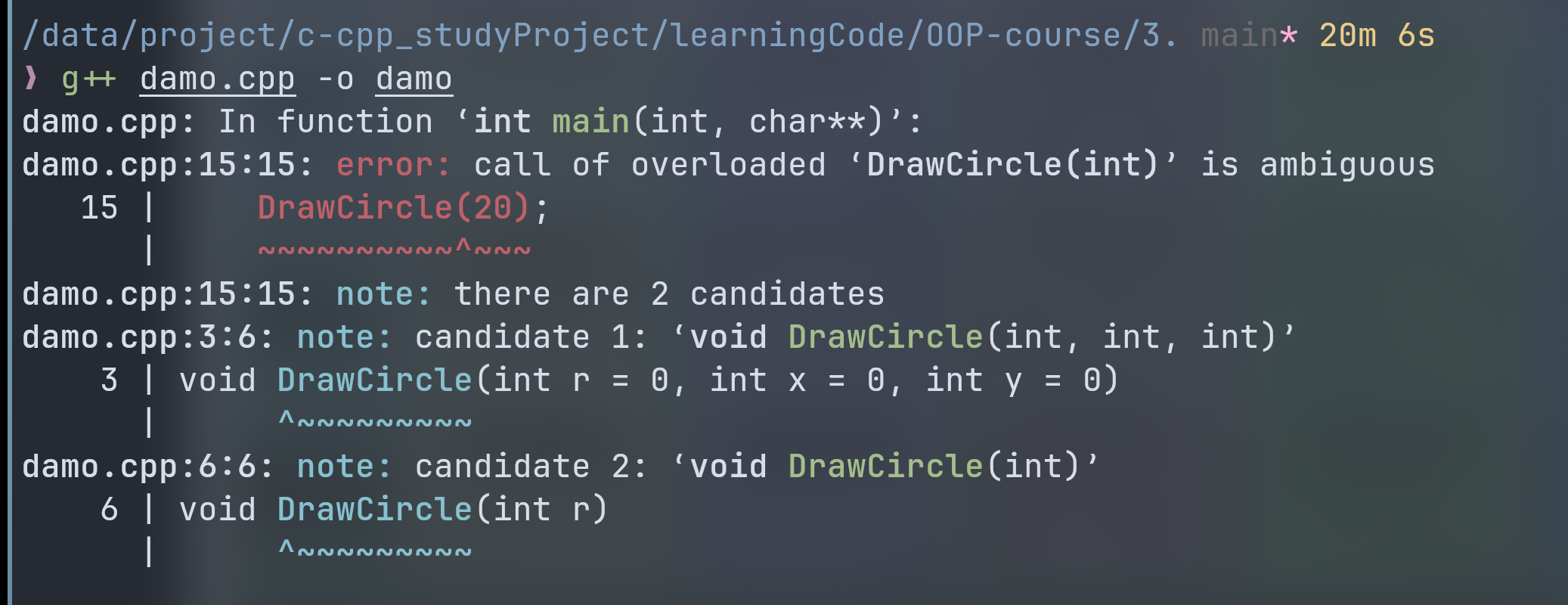
函数重载与带默认值一起使用时,有可能引起二义性。
1
2
3
4
5
6
|
void DrawCircle(int r = 0, int x = 0, int y = 0);
void DrawCircle(int r);
// 当执行以下函数时:
DrawCircle(20);
// 编译系统无法确认调用哪个函数
|
1
2
3
4
5
6
|
void f_a(int x);
void f_a(long x);
// 当执行以下的函数时:
f_a(5.56); // 编译不通过
// 编译器无法确定将 5.56 转换为 long 还是 int
|
作用域运算符 ::
如果两个变量同名,一个全局的,一个局部的,那么局部变量在其作用域内具有较高的优先级。
如果需要在函数内访问全局变量是,可以用作用域运算符:: 使用全局变量。
1
2
3
4
5
6
7
8
9
|
int a = 10;
int main(int argc, char *argv[])
{
int a = 20;
std::cout << a << std::endl;
std::cout << ::a << std::endl;
return 0;
}
|
输出:
20
10
访问命名空间的内容:
1
2
|
#include <iostream>
std::cout << " " << std::endl;
|
自己的 namespace
1
2
3
4
5
6
7
8
9
10
11
12
13
14
15
16
17
18
19
20
21
22
23
24
25
26
27
28
29
30
31
|
#include <iostream>
namespace A
{
int num = 10;
void show()
{
std::cout << "namespace A" << std::endl;
}
} // namespace A
namespace B
{
int num = 20;
void show()
{
std::cout << "namespace B" << std::endl;
}
} // namespace B
using namespace A;
int main(int argc, char *argv[])
{
A::show();
std::cout << A::num << std::endl;
B::show();
std::cout << B::num << std::endl;
show();
std::cout << num << std::endl;
return 0;
}
|
输出:
1
2
3
4
5
6
|
namespace A
10
namespace B
20
namespace A
10
|
无名联合
强制类型转换
在 C :
1
2
|
int i = 10;
float x = (float)i;
|
在 C++
1
2
|
int i = 10;
float x = float(i);
|
static_cast :
1
|
float y = static_cast<float>(i);
|
new 和 delete 运算符
在 C 语言:
1
2
3
|
int *p;
p = (int *)malloc(sizeof(int));
free(p);
|
在 C++:
1
2
3
|
int *p;
p = new int;
delete p;
|
new 分配, delete 释放
new 能够自动返回正确的指针类型,不必对返回指针进行类型转换,new 可以自动计算要分配的内存类型大小,不需要使用 sizeof() 来计算所要的字节数。
格式:
1
2
3
|
// type 为类型名,可以说基本类型,也可以是用户定义的类型,包括类
type *p = new type;
delete p;
|
使用 new 为动态数组分配内存空间:
1
|
type *p = new type[size];
|
size 可以是具体的数值,变量,有运算符的表达式。
delete 释放动态分配的数据存储区。
方括号是数组的时候用。
例:
1
2
|
float *p = new float[5];
delete [] p;
|
new 和 delete 要配对使用
1
|
p = new type[size][m][n]...[s];
|
书本勘误:
1
|
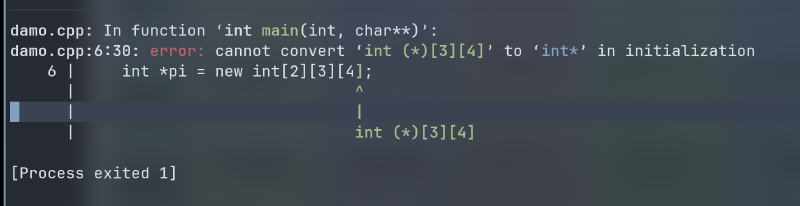
int *pi = new int[2][3][4];
|
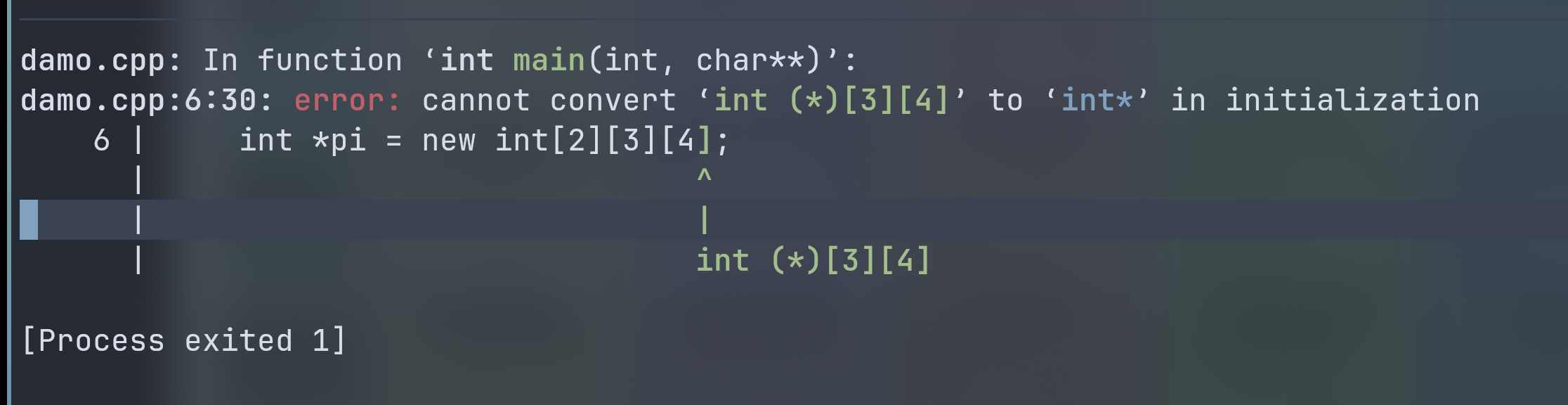
应该:
1
|
int (*p1)[4] = new int[size][4];
|
分配二维数组:
1
2
3
4
|
int size;
std::cin >> size;
int (*pi)[4] = new int[size][4];
delete[] pi;
|
在 C 语言用一维数组模拟二维数组:
1
2
3
4
5
6
7
8
9
10
11
12
13
14
15
16
17
18
19
20
21
22
23
24
|
int rows = 3;
int cols = 4;
// c 语言:用一维数组模拟二维数组
int *p1 = (int *)malloc(rows * cols * sizeof(int));
for (int i = 0; i < rows; i++)
{
for (int j = 0; j < cols; j++)
{
p1[i * cols + j] = i * cols + j;
}
}
for (int i = 0; i < rows; i++)
{
for (int j = 0; j < cols; j++)
{
std::cout << p1[i * cols + j] << "\t";
}
std::cout << std::endl;
}
return 0;
|
输出:
1
2
3
|
0 1 2 3
4 5 6 7
8 9 10 11
|
c++ :用一维数组模拟二维数组
1
2
3
4
5
6
7
8
9
10
11
12
13
14
15
16
17
18
19
20
|
// c++ :用一维数组模拟二维数组
int *p2 = new int [rows * cols];
for (int i = 0; i < rows; i++)
{
for (int j = 0; j < cols; j++)
{
p1[i * cols + j] = (i * cols + j) * (-1);
}
}
for (int i = 0; i < rows; i++)
{
for (int j = 0; j < cols; j++)
{
std::cout << p1[i * cols + j] << "\t";
}
std::cout << std::endl;
}
delete[] p2;
|
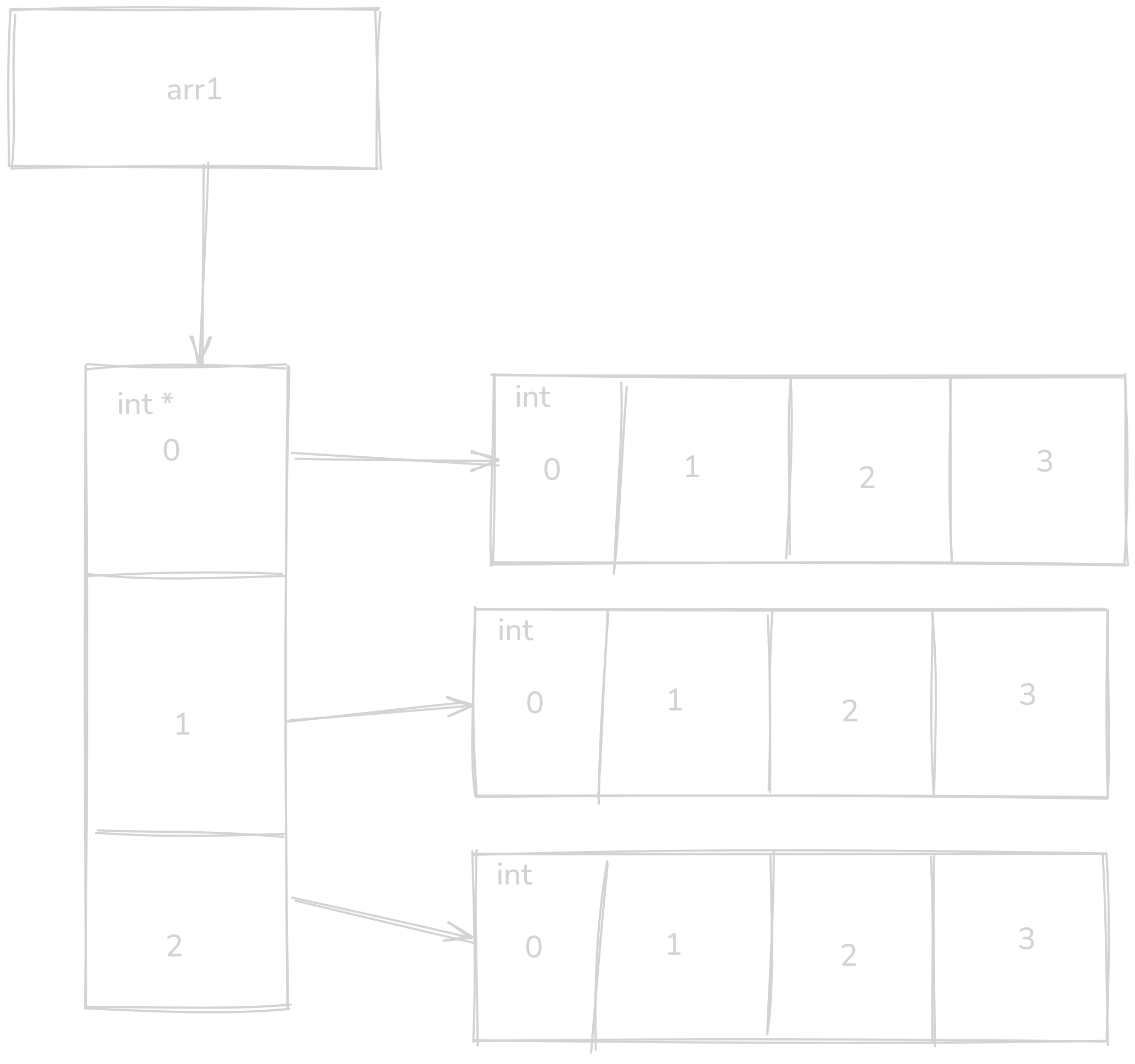
指向指针的指针,二维数组:
1
2
3
4
5
6
7
8
9
10
11
12
13
14
15
16
17
18
19
20
21
22
23
|
// C
int **arr1 = (int **)malloc(rows *sizeof(int *));
for (int i = 0; i < rows; i++)
{
arr1[i] = (int *)malloc(cols * sizeof(int));
}
for (int i = 0; i < rows; i++)
{
for (int j = 0; j < cols; j++)
{
arr1[i][j] = (i * cols + j) * 2;
}
}
for (int i = 0; i < rows; i++)
{
for (int j = 0; j < cols; j++)
{
std::cout << arr1[i][j] << "\t";
}
std::cout << std::endl;
}
|
图例:
好处:
数组可以不一样长:
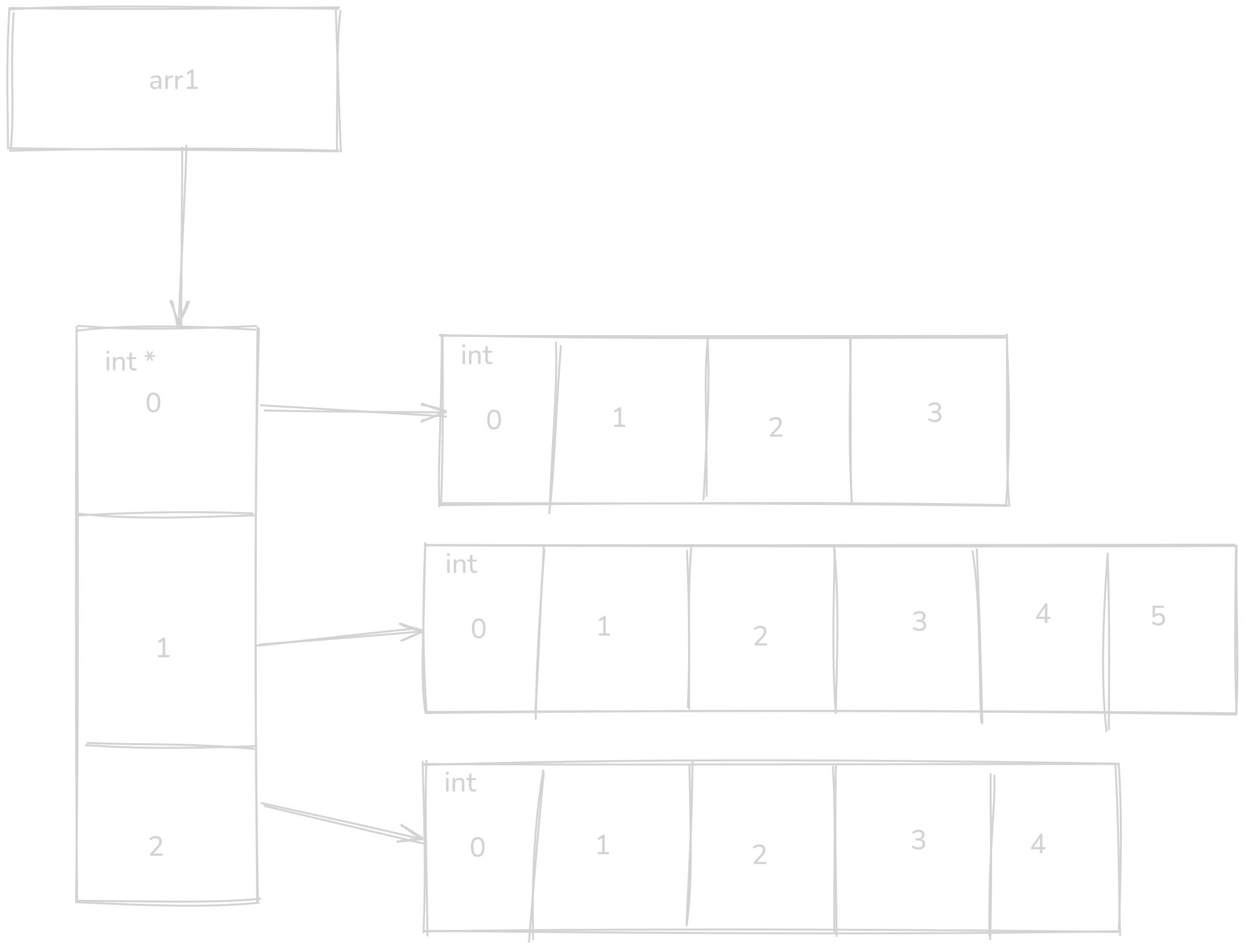
释放空间很麻烦,要 free 好多好多……
因为空间不连续,速度慢些。
C++ 同理:
1
2
3
4
5
6
7
8
9
10
11
12
13
14
15
16
17
18
19
20
21
22
23
|
// C++
int **arr2 = new int *[rows];
for (int i = 0; i < rows; i++)
{
arr1[i] = new int[cols];
}
for (int i = 0; i < rows; i++)
{
for (int j = 0; j < cols; j++)
{
arr1[i][j] = (i * cols + j) * -2;
}
}
for (int i = 0; i < rows; i++)
{
for (int j = 0; j < cols; j++)
{
std::cout << arr1[i][j] << "\t";
}
std::cout << std::endl;
}
|
和上面一样。
连续内存空间:
1
2
3
4
5
6
7
8
9
10
11
12
13
14
15
16
17
18
|
int (*p0)[4] = new int[rows][4];
for (int i = 0; i < rows; i++)
{
for (int j = 0; j < 4; j++)
{
p0[i][j] = i * 4 + j;
}
}
for (int i = 0; i < rows; i++)
{
for (int j = 0; j < 4; j++)
{
std::cout << p0[i][j] << "\t";
}
std::cout << std::endl;
}
|
列数是个常数 4 ,不能改变。
好处:空间连续,访问速度快。
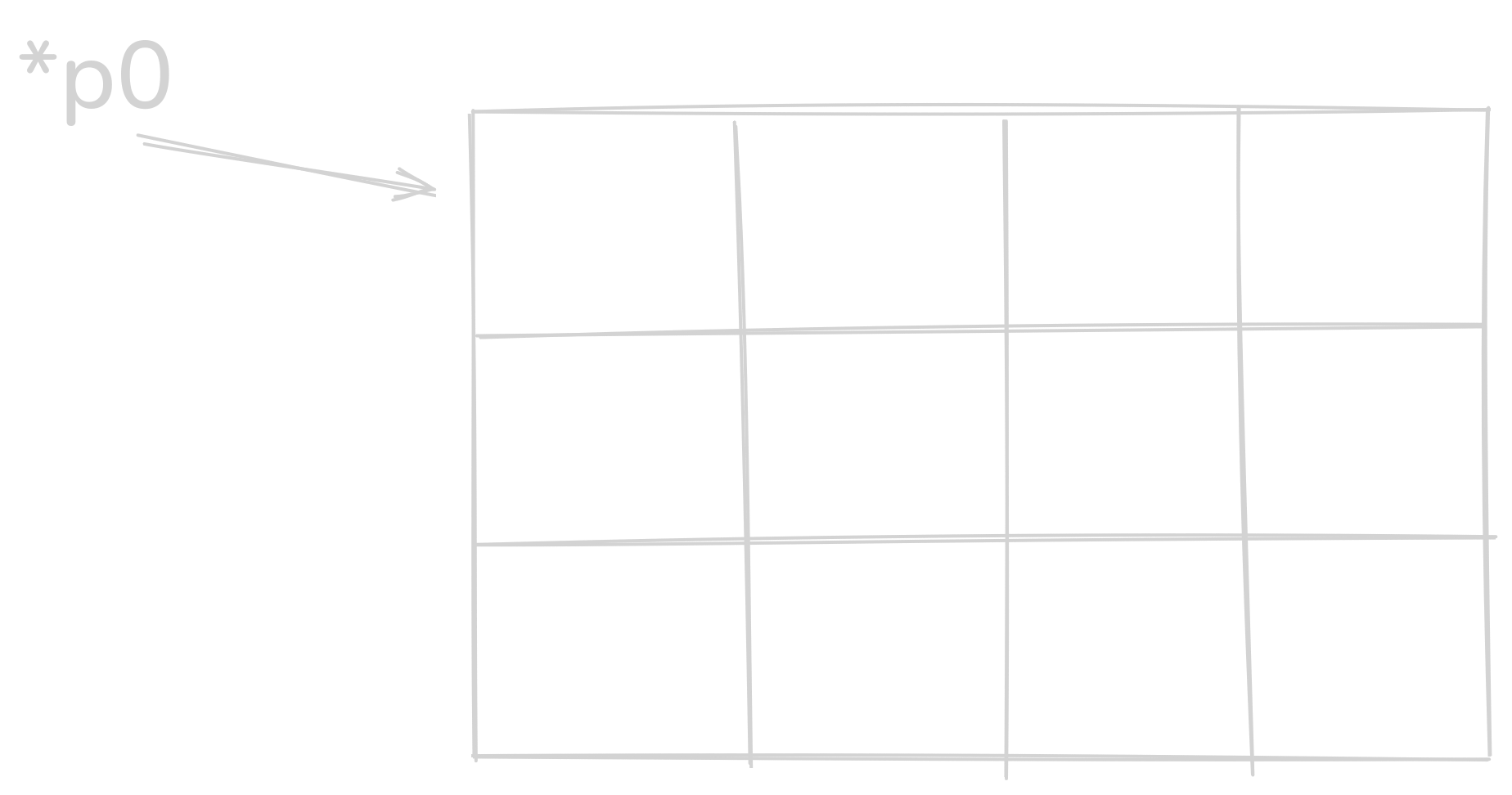 区别:
区别:
1
2
|
int *arr[4]; // 指针数组
int (*p0)[4]; // 指向数组的指针
|
用 new 分配内存的同时可以用 () 指定其初始值。
只能给单个元素,不能给数组。
对动态分配是否成功进行检查:
1
2
3
4
5
6
7
8
9
|
int *p;
p = new int;
if (!p)
{
exit(1);
}
*p = 20;
std::cout << *p << std::endl;
delete p;
|
非常大的数组不抛出异常:
1
|
p = new (std::nothrow) int[1000000000000000000000];
|
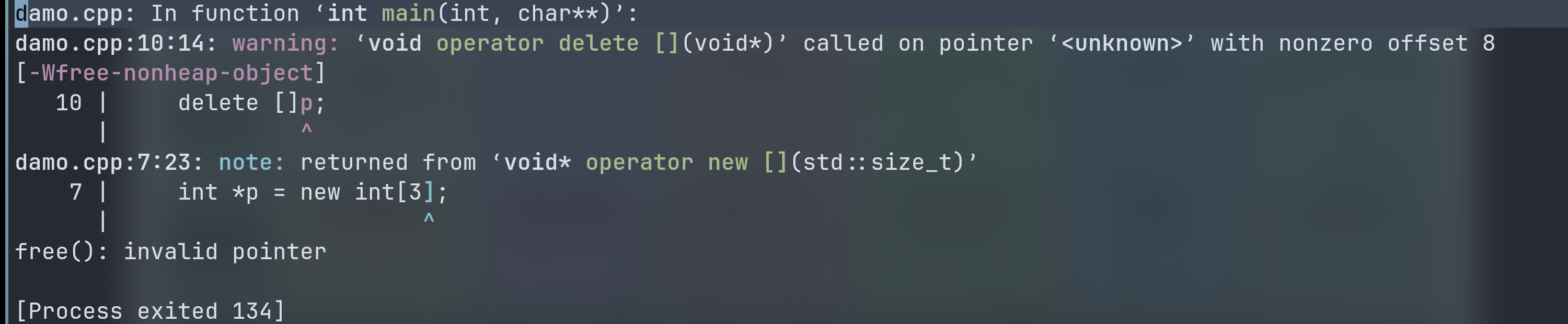
对指针做位移,释放错误。
1
2
3
|
int *p = new int[3];
p = p + 2;
delete []p;
|
报错:
引用
引用给一个变量起别名。对引用的任何操作都是对引用目标的操作。
例:
1
2
|
int i = 5;
int &j = 1; // 声明 j 是一个整型变量的引用
|
特点:
- 类型必须匹配
- 引用必须在声明是初始化,不能重新绑定
- 引用就是别引用对象的别名,不额外占据内存。和被引用的目标共同占有内存。
如果引用不是用作函数的参数或返回值,在说明时必须进行初始化。
为引用提供的初始值,可以说一个变量或另一个引用。
引用仅在声明时带有引用运算符 &,以后就像普通变量一样引用,不能再带 &
在表达式中使用的 & 都是地址符。
1
2
3
|
int num = 50;
int &ref = num; // 引用符
int *p = &ref; // 地址符
|
1
2
3
4
5
|
int j = 5, k = 3;
int &i = j; // 声明引用 i,& 为引用符
i = k; // WARN: 把 k 赋值给 i
int *pi = &i; // & 为地址符
std::cout << *pi;
|
输出: 3
并不是任何类型的数据都可以引用
1
2
3
4
|
void &r = 10; // 不能建立 void 类型的引用
int a[4] = {1, 2, 3, 4};
int &ra[4] = a; // 不能建立引用的数组
|
- 不能建立 void 类型的引用
引用的右值不能是常量:
总不能 10++ 吧??
应该要加 const
也可以右值引用:
1
2
|
int &&r2 = 10;
r2++; // 此时:r2 = 11
|
1
2
3
4
|
int a[4] = {1, 2, 3, 4};
int &ra[4] = a; // 不能
// 从变量开始往外读,按照优先级:先读到[]
// ra 是个数组,每个元素都是引用。
|
没办法建立一个数组,里面都是引用
1
2
|
int x = 1, y = 2, z = 3, w = 4;
int &ra[4] = {x, y, z, w};
|
指向数组的引用应该这样写:
加上括号,改变优先级
1
2
|
int a[4] = {1, 2, 3, 4};
int (&ra)[4] = a;
|
1
2
3
4
5
6
|
int n = 3;
int &&r = n; // 不能
int &*p = n; // 不能 从变量开始往外读,
// 先遇到 * ,所以 p 是个指针,
// 再往外是个应用,所以是指向引用的指针
// 但是不能建立一个指向引用的指针
|
下面可以。指向指针的引用
1
2
3
|
int n = 3;
int *ptr = &n;
int *&p1 = ptr; // 指针的引用
|
引用作为函数参数
1
2
3
4
5
6
7
8
9
10
11
12
13
14
15
16
|
#include <iostream>
void swap(int &a, int &b)
{
int tmp = a;
a = b;
b = tmp;
}
int main(int argc, char *argv[])
{
int x = 4, y = 5;
std::cout << "x = " << x << "; y = " << y << std::endl;
swap(x, y);
std::cout << "x = " << x << "; y = " << y << std::endl;
return 0;
}
|
返回函数值是引用
允许我们修改函数返回值。
 1
 2
 3
 4
 5
 6
 7
 8
 9
10
11
12
13
14
15
16
17
18
19
20
21
22
23
24
|
// Function returns a reference to an element in the array
int& getElement(int arr[], int index) {
    return arr[index];
}

int main() {
    int numbers[5] = {10, 20, 30, 40, 50};

    // Use reference return to modify the array
    getElement(numbers, 2) = 99;

    // Print the array to see the change
    for (int i = 0; i < 5; ++i) {
        cout << numbers[i] << " ";
    }
    cout << endl;
    return 0;
}

// 返回值是可以被修改的
int& max(int& num1, int& num2)
{
    return (num1 > num2) ? num1 : num2;
}
|